
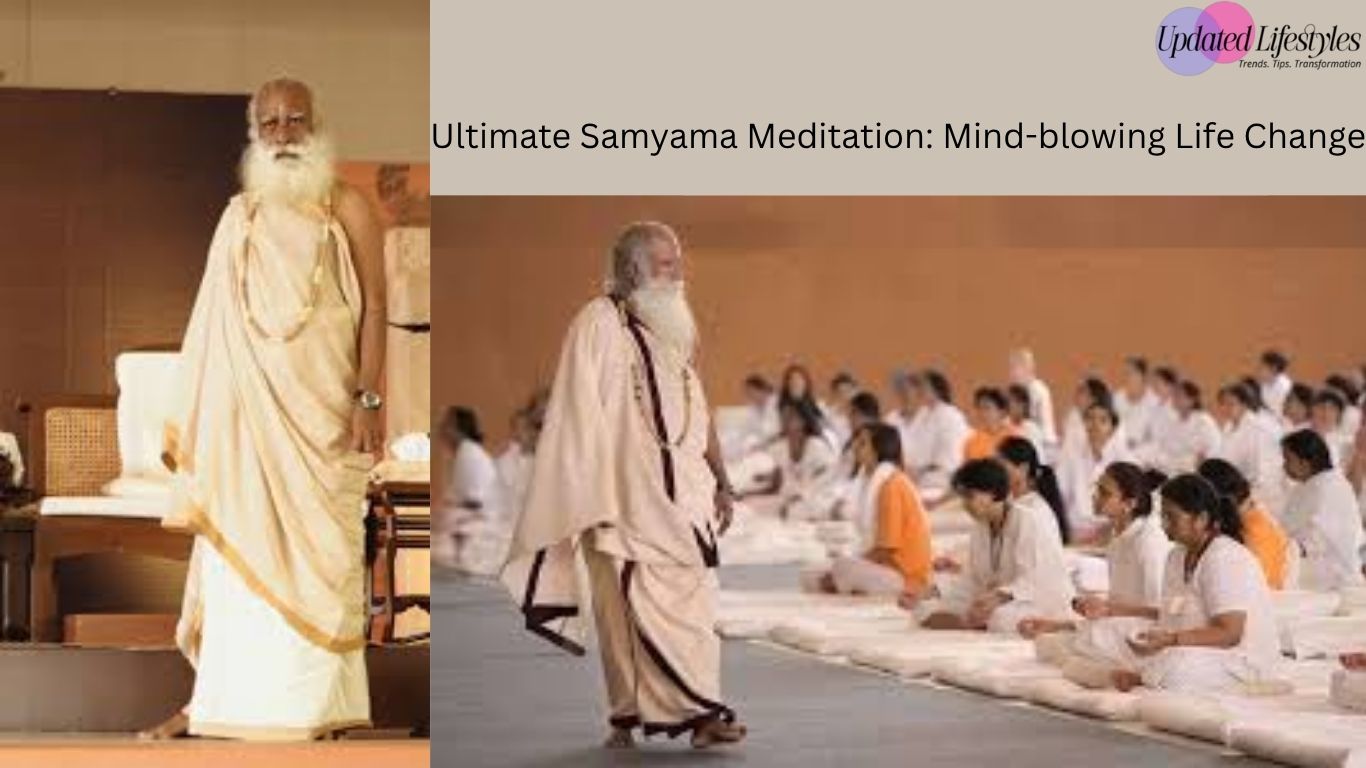
Samyama meditation isn’t just another mindfulness practice – it’s an ancient yogic technique that can completely transform how you experience reality and unlock extraordinary mental abilities.
This powerful three-stage meditation method is perfect for experienced meditators ready to deepen their practice, spiritual seekers wanting to develop intuitive insights, and anyone curious about accessing heightened states of consciousness.
You’ll discover the foundational principles that make Samyama so effective at creating profound inner shifts. We’ll also walk through practical techniques you can start using today to experience these mind-expanding benefits yourself. Plus, you’ll learn how to apply this meditation in your daily life for lasting personal transformation.
Get ready to explore a practice that ancient yogis considered the gateway to supernatural abilities and modern practitioners use to unlock their full potential.
Understanding Samyama Meditation and Its Transformative Power
Ancient Yogic Practice for Modern Life Challenges
Samyama meditation traces back over 2,000 years to Patanjali’s Yoga Sutras, where it’s described as the pinnacle of yogic practice. This isn’t just another meditation technique – it’s a sophisticated consciousness technology designed to unlock human potential. While ancient sages practiced Samyama in caves and forests, today’s practitioners discover its remarkable relevance for navigating our hyperconnected, stress-filled world.
The beauty of Samyama lies in its practical application to everyday challenges. Whether you’re struggling with decision paralysis at work, seeking creative breakthroughs, or dealing with relationship conflicts, this practice offers direct access to intuitive wisdom that cuts through mental noise. Unlike passive relaxation techniques, Samyama actively trains your mind to penetrate deeper layers of consciousness where solutions naturally emerge.
What makes this practice particularly powerful for modern life is its ability to work with our overstimulated nervous systems. While we’re constantly bombarded with information, Samyama teaches you to focus your attention with laser precision, transforming mental chaos into clarity and purpose.
Three-Stage Process That Rewires Your Brain
Samyama operates through three distinct yet interconnected stages that progressively deepen your consciousness. The first stage, Dharana, involves concentrated focus on a single object, thought, or intention. This isn’t ordinary concentration – you’re training your mind to hold steady attention without strain or force.
The second stage, Dhyana, emerges when concentration becomes effortless and unbroken. Your awareness flows naturally toward your chosen focus, like a steady stream of oil pouring from one vessel to another. This stage often feels like a gentle melting of the boundary between observer and observed.
The final stage, Samadhi, represents complete absorption where the sense of separate self dissolves. You become one with your object of meditation, accessing direct knowing rather than conceptual understanding. This isn’t a mystical state reserved for advanced practitioners – with proper guidance, beginners often touch this experience in their early sessions.
The Progressive Stages:
- Dharana: Focused concentration with effort
- Dhyana: Effortless sustained awareness
- Samadhi: Complete absorption and unity
Each stage naturally leads to the next, creating a powerful feedback loop that literally rewires your brain’s neural pathways for enhanced perception and decision-making.
Scientific Evidence Behind Consciousness Expansion
Neuroscience research validates what yogis have known for millennia – Samyama practice creates measurable changes in brain structure and function. Studies using EEG and fMRI technology show that experienced practitioners exhibit increased gamma wave activity, associated with heightened awareness and cognitive processing.
Dr. Judson Brewer’s research at Yale demonstrates that meditation practices like Samyama significantly reduce activity in the default mode network – the brain regions responsible for self-referential thinking and mental chatter. This reduction correlates with decreased anxiety, depression, and rumination.
Brain imaging studies reveal that regular Samyama practice increases gray matter density in areas linked to learning, memory, and emotional regulation while reducing amygdala reactivity to stress. These changes aren’t temporary – they represent lasting neuroplasticity that continues evolving with consistent practice.
Key Research Findings:
- Increased gamma wave coherence across brain regions
- Enhanced prefrontal cortex function for decision-making
- Reduced amygdala hyperactivity and stress response
- Improved interoceptive awareness and body-mind connection
The most fascinating discovery is how Samyama appears to synchronize different brain networks, creating a state of coherent consciousness that researchers are only beginning to understand.
How Samyama Differs from Regular Meditation
While most meditation practices focus on relaxation or mindfulness, Samyama is precision-engineered for specific outcomes. Regular meditation might help you feel calmer, but Samyama helps you access insights, solve problems, and manifest desired changes in your life.
Traditional mindfulness meditation observes thoughts without attachment, creating space between you and your mental activity. Samyama takes a different approach – you deliberately engage with chosen thoughts, ideas, or intentions to unlock their deeper dimensions. This active engagement leads to breakthrough moments of understanding that passive observation rarely provides.
The intensity also differs significantly. While mindfulness can be practiced casually throughout the day, Samyama requires dedicated sessions with specific protocols. You’re not just sitting quietly – you’re systematically penetrating layers of consciousness with focused intention.
Comparison Table:
| Aspect | Regular Meditation | Samyama Meditation |
|---|---|---|
| Goal | Relaxation, awareness | Specific insights, manifestation |
| Approach | Passive observation | Active engagement |
| Focus | Present moment | Chosen object/intention |
| Outcome | General well-being | Targeted transformation |
| Duration | Flexible | Structured sessions |
Samyama also produces rapid results compared to other practices. While traditional meditation might take months to show significant benefits, many practitioners report profound shifts within weeks of consistent Samyama practice. This accelerated timeline makes it particularly appealing for goal-oriented individuals seeking tangible life improvements.
Mastering the Three Pillars of Samyama Practice
Dharana – Achieving Laser-Sharp Focus
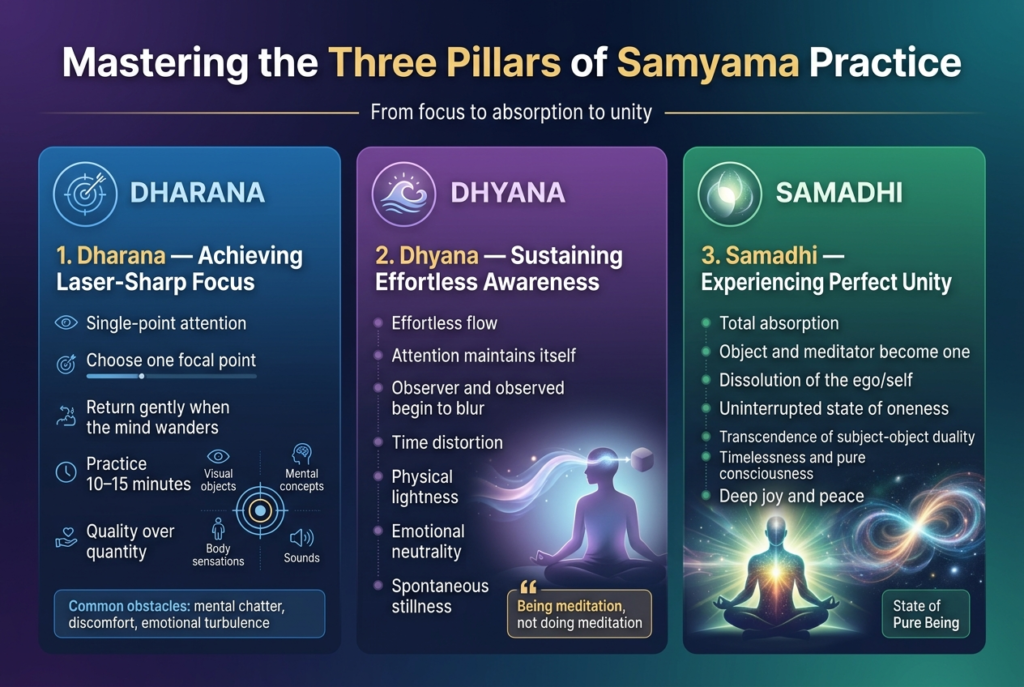
Dharana represents the foundation of Samyama practice, where you develop unwavering concentration on a single point of attention. Think of it as training your mind to become a laser beam rather than a scattered flashlight. This isn’t about forcing your thoughts into submission – it’s about gently guiding your awareness to rest on one chosen object.
Start by selecting your focal point carefully. Traditional options include:
- Visual objects: A candle flame, sacred symbol, or natural element
- Mental concepts: Love, peace, or specific qualities you wish to cultivate
- Body sensations: Breath at the nostrils or heart center
- Sounds: Mantras, nature sounds, or internal vibrations
The key lies in consistency. When your mind wanders (and it will), simply return to your chosen focus without judgment. Each return strengthens your concentration muscle. Professional meditators often compare this to training at the gym – every repetition builds strength.
Common obstacles include mental chatter, physical discomfort, and emotional turbulence. Rather than fighting these distractions, acknowledge them with kindness and redirect your attention. Remember, Dharana isn’t about achieving perfect stillness immediately. It’s about developing the skill to maintain sustained focus for progressively longer periods.
Practice for 10-15 minutes initially, gradually extending your sessions as your concentration deepens. Quality trumps quantity every time.
Dhyana – Sustaining Effortless Awareness
Dhyana emerges naturally when Dharana matures into effortless flow. Here, the struggle dissolves, and maintaining focus becomes as natural as breathing. Your awareness streams steadily toward your chosen object without forced effort or constant redirection.
This stage feels like being absorbed in a captivating book or losing yourself in beautiful music – time seems to dissolve, and self-consciousness fades. The difference between the observer (you) and the observed (your focal point) begins to blur, creating a sense of unified experience.
Signs you’ve entered Dhyana include:
- Spontaneous stillness: Thoughts settle naturally without effort
- Time distortion: Minutes feel like seconds or hours
- Physical lightness: Body sensations become subtle or disappear
- Emotional neutrality: Pleasant and unpleasant experiences hold equal weight
- Effortless attention: Focus maintains itself without conscious control
Don’t chase these experiences or try to manufacture them. Dhyana cannot be forced – it arises spontaneously when conditions align properly. Your role shifts from actively concentrating to simply witnessing whatever unfolds.
Many practitioners describe this as “being meditation” rather than “doing meditation.” The practice becomes a state of being rather than a technique you perform. Trust the process and allow your awareness to settle into this natural rhythm.
Samadhi – Experiencing Unity Consciousness
Samadhi represents the pinnacle of Samyama practice, where individual consciousness merges completely with the object of meditation. The boundaries between self and other dissolve entirely, revealing the underlying unity that connects all existence.
In this state, you don’t observe your focal point – you become it. If meditating on love, you become love itself. If focusing on peace, you embody peace completely. This isn’t metaphorical or philosophical – it’s a direct, unmistakable experience of non-dual awareness.
Different levels of Samadhi offer varying depths of realization:
| Type | Characteristics | Experience |
|---|---|---|
| Savikalpa | Subtle awareness remains | Unity with form/concept |
| Nirvikalpa | Complete dissolution | Pure consciousness only |
| Sahaja | Natural state | Integrated awakening |
Samadhi transforms your fundamental understanding of reality. You realize that separation is an illusion created by the thinking mind. This recognition doesn’t fade when you return to ordinary consciousness – it becomes an underlying knowing that influences every aspect of life.
The effects ripple outward, transforming relationships, work, and daily activities. Problems that once seemed overwhelming reveal themselves as temporary fluctuations in consciousness. Fear diminishes as you recognize your essential nature as infinite awareness.
Don’t attempt to achieve Samadhi through willpower or technique manipulation. It emerges naturally through consistent practice of Dharana and Dhyana. Your job is creating optimal conditions and allowing this profound transformation to unfold in its own perfect timing.
Step-by-Step Guide to Your First Samyama Session
Creating the Perfect Meditation Environment
Your meditation space acts as a sacred container for your Samyama practice. Choose a quiet corner where interruptions are minimal – this could be your bedroom, a spare room, or even a dedicated outdoor spot. The key is consistency. Using the same location each time helps your mind slip into meditative states more easily.
Temperature matters more than you might think. Keep your space slightly cool, around 68-72°F, as body heat naturally rises during deep meditation. Poor ventilation can make you drowsy and unfocused. Open a window or use a fan if needed, but avoid direct air flow on your body.
Lighting should be soft and natural when possible. Harsh fluorescent lights can agitate your nervous system, while complete darkness might make you sleepy. A dimmed lamp or filtered sunlight creates the ideal ambiance. Some practitioners prefer a single candle, though this isn’t necessary.
Your seating arrangement directly impacts your success. A firm cushion on the floor works well, but a straight-backed chair is perfectly acceptable. Your spine should remain naturally erect without strain. Avoid beds or recliners that encourage slouching – they’ll sabotage your alertness.
Remove or silence electronic devices. Even on silent mode, phones emit electromagnetic fields that can disturb subtle energetic states. If you must keep a phone nearby for timing, place it at least six feet away.
Selecting Your Object of Concentration
Traditional Samyama practice works with specific objects called “dharana” – focal points that anchor your attention. For beginners, simple geometric forms prove most effective. A mental image of a bright golden sphere works beautifully. Visualize it as perfectly round, luminous, and stable in your mind’s eye.
Physical objects can serve as training wheels before moving to purely mental images. A small candle flame, a flower, or even a dot drawn on paper helps establish the concentration foundation. Spend 5-10 sessions with a physical object before transitioning to mental visualization.
Some practitioners prefer abstract concepts like “peace” or “love.” While these can be profound, they’re more challenging for newcomers because they lack the concrete structure that geometric forms provide. Save conceptual meditation for later stages of your practice.
Your breath can serve as an excellent starting point, though it differs from traditional Samyama objects. Focus on the sensation of air entering and leaving your nostrils. This builds concentration skills that transfer directly to visual objects.
Avoid complex or emotionally charged imagery initially. Pictures of deities, loved ones, or religious symbols can trigger mental chatter and emotional reactions that disrupt the subtle awareness Samyama requires.
Progressing Through Each Stage Naturally
Dharana, the first stage, involves steady, unwavering focus on your chosen object. Don’t fight wandering thoughts – simply notice them and gently redirect attention back to your focal point. This stage typically lasts 10-15 minutes for beginners, though some may need longer to stabilize their concentration.
You’ll know you’re ready for Dhyana (meditation proper) when maintaining focus becomes effortless. The object appears clearly in your awareness without strain, and periods of distraction become shorter and less frequent. This transition might happen within a single session or take weeks of practice.
During Dhyana, your sense of effort dissolves. The object seems to maintain itself in your awareness while you become a passive observer. Time distortion often occurs – five minutes might feel like an hour, or thirty minutes might pass like moments. Your body may feel very heavy or completely weightless.
Samadhi, the final stage, arrives when the boundary between you and your object disappears. You’re not observing the golden sphere – you become the sphere. This isn’t imagination or visualization anymore; it’s a direct experience of unity. Most practitioners touch this state only briefly at first.
Don’t chase dramatic experiences or try to force progression. Each stage unfolds naturally when the previous one is stable. Some days you’ll stay in Dharana, other days you might glimpse Samadhi. Both are perfectly normal and valuable.
Common Mistakes That Block Your Progress
Forcing concentration creates tension that prevents natural deepening. Many beginners grip their attention like a clenched fist, creating mental strain and headaches. True Samyama feels more like holding a soap bubble – firm enough to maintain, gentle enough not to burst it.
Judging your meditation quality during the session interrupts the flow state you’re trying to achieve. Thoughts like “Am I doing this right?” or “This isn’t working” pull you out of the meditative process. Save evaluation for after your session ends.
Inconsistent timing undermines progress significantly. Meditating for 45 minutes one day and 5 minutes the next doesn’t allow your nervous system to adapt and stabilize. Start with 15-20 minutes daily rather than longer, irregular sessions.
Physical discomfort that goes unaddressed becomes a major distraction. Adjust your posture when needed, but do so mindfully and minimally. Sharp pain requires immediate attention – meditation isn’t meant to be physically painful.
Expecting immediate dramatic results sets you up for disappointment. Samyama’s benefits accumulate gradually over weeks and months. Some people experience profound shifts early on, while others need more time. Neither path is superior.
Mixing too many meditation techniques confuses your nervous system. Stick with traditional Samyama methods for at least 6-8 weeks before experimenting with other approaches. Jumping between styles prevents you from developing the specific neural pathways Samyama requires.
Recognizing Signs of Deepening Practice
Physical sensations often signal advancing meditation depth. Your breathing naturally slows and deepens without conscious effort. Heart rate decreases, and muscle tension releases progressively throughout your body. Some practitioners experience warmth, tingling, or gentle pulsing sensations.
Mental clarity increases both during and after sessions. Racing thoughts slow down, and the gaps between thoughts become more noticeable. Your chosen object appears more vivid and stable in awareness. Distractions lose their compelling power and fade quickly when they arise.
Time perception shifts mark deeper states. You might lose track of time completely or experience it as elastic – stretching and contracting unpredictably. When you emerge from meditation, it might feel like you’ve been in a different dimension entirely.
Emotional states stabilize and become more positive. Anxiety, irritation, and restlessness decrease both during practice and in daily life. A gentle, peaceful contentment often lingers for hours after meditation. Problems that seemed overwhelming begin feeling more manageable.
Spontaneous insights and creative solutions arise without effort. Your mind becomes clearer and more intuitive. You might find yourself knowing things without knowing how you know them – a sign that deeper intelligence is awakening.
Energy levels improve paradoxically. Despite sitting still for extended periods, you feel more energized and alert afterward. Sleep quality often improves, and you may need less sleep overall while feeling more rested.
Life-Changing Benefits You Can Expect
Enhanced Intuition and Decision-Making
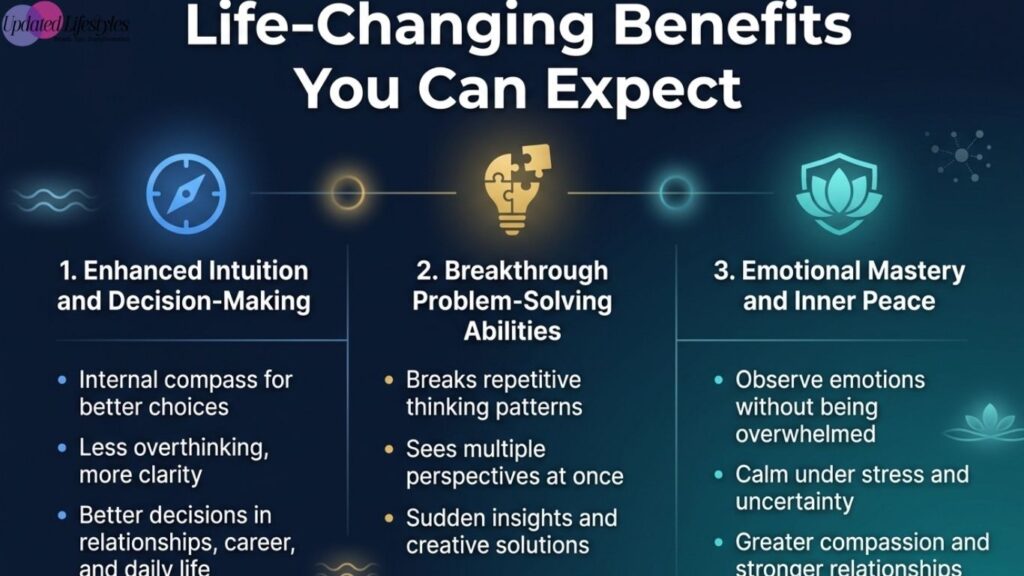
Samyama meditation creates a profound shift in how your mind processes information and makes choices. Practitioners consistently report experiencing what feels like an internal compass that guides them toward optimal decisions without overthinking every detail.
This heightened intuitive ability emerges from the deep states of awareness that Samyama cultivates. Your brain begins operating from a more integrated perspective, accessing subtle information patterns that typically remain below conscious awareness. Decision-making transforms from a stressful mental wrestling match into a clear, confident process.
Many meditators describe experiencing “knowing without knowing how they know” – a direct insight that bypasses analytical processing yet proves remarkably accurate. This isn’t mystical thinking; neuroscience research shows that meditation enhances communication between different brain regions, allowing for more comprehensive information processing.
The practical impact is immediate. You’ll find yourself making better choices about relationships, career moves, and daily decisions with less mental fatigue. Complex situations that once required endless deliberation become clearer through this enhanced perceptual ability.
Breakthrough Problem-Solving Abilities
Samyama meditation rewires your approach to challenges and obstacles. The practice dissolves the mental rigidity that keeps us trapped in repetitive thinking patterns, opening pathways to creative solutions that weren’t previously visible.
During Samyama practice, your mind learns to hold multiple perspectives simultaneously without attachment to any single viewpoint. This mental flexibility translates directly into real-world problem-solving. Challenges that seemed impossible begin revealing unexpected solutions.
The breakthrough moments often arrive during or shortly after meditation sessions. Your unconscious mind continues processing problems while you’re in deep meditative states, frequently delivering insights that feel like sudden downloads of understanding. These solutions typically address root causes rather than surface symptoms.
Creative professionals, entrepreneurs, and researchers particularly benefit from this enhanced cognitive flexibility. The practice helps you see beyond conventional approaches and discover innovative angles that others miss. Problems become puzzles to explore rather than walls to hit your head against.
Emotional Mastery and Inner Peace
Perhaps the most life-altering benefit of Samyama meditation is the profound emotional stability it creates. The practice develops an unshakeable inner foundation that remains calm regardless of external circumstances.
Samyama teaches you to observe emotions without being overwhelmed by them. You develop the ability to feel deeply while maintaining perspective. Anger, fear, and anxiety lose their grip as you learn to witness these states without identification. This doesn’t mean becoming emotionally numb; instead, you experience feelings more fully while remaining centered.
The peace that emerges isn’t dependent on perfect conditions or the absence of challenges. It’s a dynamic equilibrium that adapts to life’s natural fluctuations while maintaining essential stability. Stress responses become more appropriate to actual threats rather than imagined fears.
Relationships improve dramatically as emotional reactivity decreases. You respond to conflicts from wisdom rather than wounded reactions. This emotional mastery creates space for compassion and understanding, transforming how you connect with others and yourself.
Advanced Techniques for Accelerated Results
Working with Subtle Objects of Concentration
Once you’ve mastered basic concentration techniques, transitioning to subtle objects marks a significant leap in your practice. Start with abstract concepts like compassion, peace, or love. These intangible targets challenge your mind differently than physical objects, requiring deeper states of awareness.
Begin by selecting a quality you want to develop. Hold the essence of compassion in your awareness without trying to visualize it. Feel its energy, its warmth, its boundless nature. Your mind will naturally try to create images or memories – gently redirect attention back to the pure feeling itself.
Sound vibrations offer another powerful gateway. Work with internal mantras or the subtle hum of silence between thoughts. The space between breaths becomes your meditation object, training concentration on increasingly refined phenomena.
Energy centers within the body provide excellent focal points for advanced practitioners. Direct attention to your heart center while maintaining the three-fold practice of dharana, dhyana, and samadhi. Notice how awareness shifts from gross sensations to subtle pulsations of life force.
The key breakthrough happens when you stop efforting. Subtle objects require a gentle touch – like holding a butterfly without crushing its wings. Force kills the delicate connection that allows deeper states to unfold naturally.
Integrating Samyama into Daily Activities
Daily integration transforms sporadic meditation sessions into continuous spiritual practice. Walking meditation offers an ideal starting point – each step becomes an opportunity to practice dharana on the sensation of movement while maintaining meditative awareness.
During conversations, practice concentrated listening. Focus completely on the speaker’s words, tone, and energy while simultaneously observing your own reactions without judgment. This dual awareness builds the mental muscles needed for advanced samyama.
Eating provides rich sensory material for practice. Before each meal, spend two minutes applying samyama to your food’s appearance, aroma, and texture. Chew slowly while maintaining complete attention on taste sensations. This simple practice develops extraordinary sensitivity and presence.
Transform routine tasks into spiritual exercises. While washing dishes, concentrate fully on water temperature, soap texture, and the circular motions of cleaning. When walking up stairs, make each step a meditation on effort and gravity. Even checking email can become practice – read with complete attention before responding.
The secret lies in choosing one activity per day for concentrated practice rather than trying to be mindful all the time. Start with five-minute sessions during natural breaks. Your nervous system adapts gradually, making longer periods feel effortless.
Create transition moments between activities. Take three conscious breaths while moving from one task to another. These micro-meditations build momentum throughout your day.
Building Consistent Practice Momentum
Consistency beats intensity every time. Start with realistic commitments you can actually maintain – five minutes daily outperforms sporadic hour-long sessions. Your brain thrives on predictable patterns that gradually become automatic.
Track your practice using simple metrics. Note session length, clarity level (1-10), and any insights in a brief journal entry. Seeing progress on paper motivates continued effort during difficult periods when benefits feel invisible.
Link samyama practice to established habits. Meditate immediately after morning coffee or before evening meals. This technique called “habit stacking” leverages existing neural pathways to support new behaviors.
Prepare your practice space the night before. Lay out your meditation cushion, journal, and any props you use. Removing friction between intention and action dramatically increases follow-through rates.
Design flexibility into your routine. Create three practice options: ideal (20 minutes), realistic (10 minutes), and minimum viable (3 minutes). Having backup plans prevents all-or-nothing thinking that destroys momentum when life gets busy.
Connect with other practitioners through online communities or local groups. Sharing experiences and challenges with like-minded people provides accountability and inspiration during rough patches.
Conclusion
Samyama meditation offers a complete transformation system that goes far beyond typical relaxation techniques. By mastering its three core pillars and following the structured practice guide, you’re setting yourself up for profound shifts in awareness, clarity, and personal power. The benefits extend into every corner of your life – from enhanced focus at work to deeper relationships and a stronger sense of inner peace.
Ready to experience these life-changing results for yourself? Start with just 10-15 minutes of daily practice using the beginner techniques outlined above. Remember, consistency beats intensity every time. As you build confidence with the basics, gradually incorporate the advanced methods and real-world applications. Your future self will thank you for taking this first step toward unlocking your mind’s incredible potential through Samyama meditation.